
Nerve Tape®
Sutureless
Connector
Nerve Tape is designed to simplify nerve repair,
connecting nerves without the need for microsutures.1,2
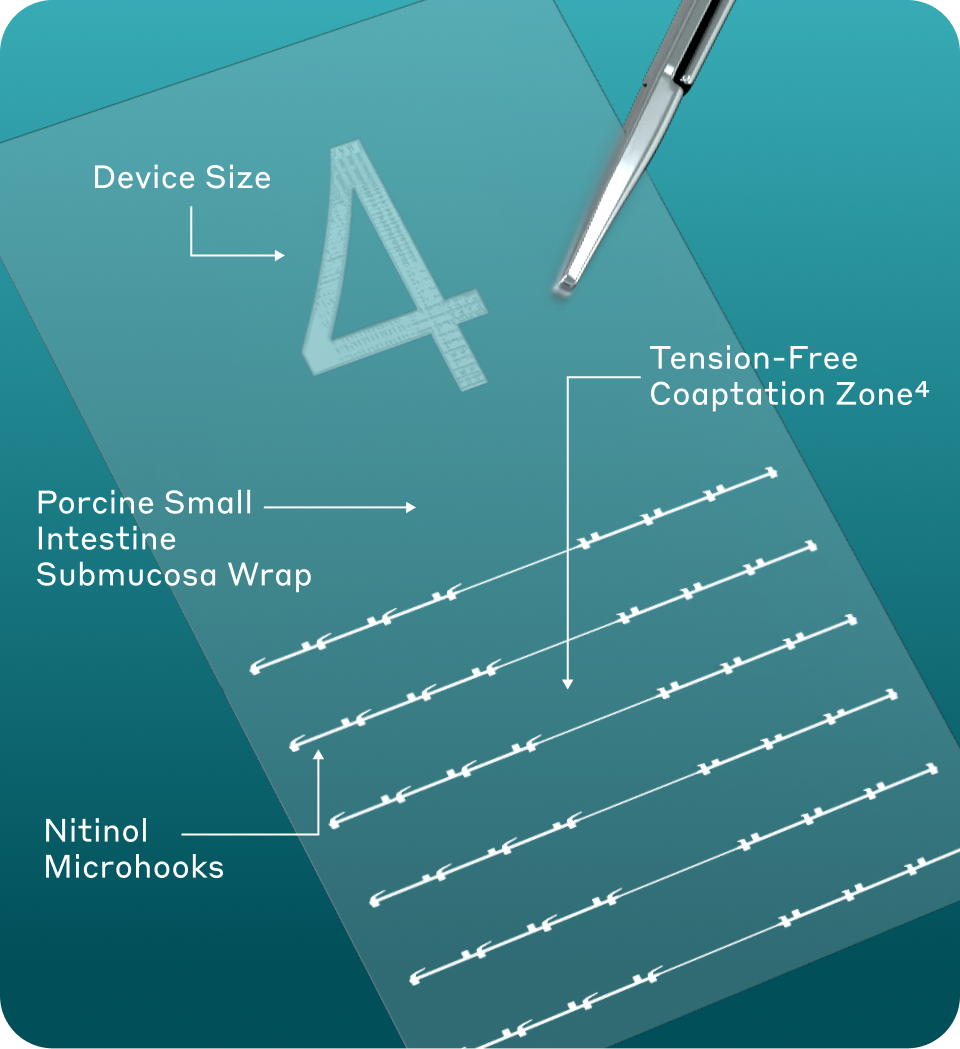
Sutureless nerve repair
- Encloses the coaptation to create a stable, entubulated repair3
- Open wrap design may reduce the risk of constriction compared with hollow tube conduits3
Nitinol Microhooks
- Provides a quick sutureless connection2
- Multiple fixation points help distribute tension away from the coaptation3,4
- Fixed penetration depth supports controlled engagement of the epineurium3
- Supports precise alignment of nerve ends2
- Splints, directs, and supports alignment of fascicles1
- Maintains approximated nerve ends within the repair construct3,4
Ordering and sizing
| Code | Dimensions |
|---|---|
| NT15-14 | 1.5 mm x 14 mm |
| NT20-14 | 2.0 mm x 14 mm |
| NT30-14 | 3.0 mm x 14 mm |
| NT40-16 | 4.0 mm x 16 mm |
| NT50-16 | 5.0 mm x 16 mm |
| NT60-22 | 6.0 mm x 22 mm |
| NT70-22 | 7.0 mm x 22 mm |
Connect with an Axogen rep for more information
Microsuture vs. Nerve Tape

Faster repair
4.5xfaster than microsuture2
Mean repair time
In a cadaveric study, Nerve Tape repairs were performed an average of 4.5x faster than microsuture repairs.2

Higher peak tensile force
2.6xhigher than microsuture2
Average peak tensile force
In cadaveric testing, Nerve Tape repairs demonstrated a 2.6x higher average peak tensile force than microsuture repairs.2


References:
- Bendale GS, Sonntag M, Clements IP, Isaacs JE. Biomechanical testing of a novel device for sutureless nerve repair. Tissue Eng Part C Methods. 2022;28(9):469-475. doi:10.1089/ten.TEC.2022.0080
- Eberlin KR, Safa B, Buntic R, et al. Usability of Nerve Tape: a novel sutureless nerve coaptation device. J Hand Surg Am. 2024;49(4):346-353. doi:10.1016/j.jhsa.2024.01.001
- Bendale G, Smith M, Daniel L, et al. In vivo efficacy of a novel, sutureless coaptation device for repairing peripheral nerve defects. Tissue Eng Part A. 2023;29(17-18):461-470. doi:10.1089/ten.TEA.2023.0004
- Smetana B, Loflin B, Isaacs J, et al. Strain shielding effects of a novel microhook-based nerve repair device. Abstract presented at: AAHS Annual Meeting; January 14-18, 2025; Waikoloa Village, HI.
IMPORTANT SAFETY INFORMATION
Indications for Use
Nerve Tape® is indicated for the repair of peripheral nerve discontinuities where gap closure can be achieved by flexion of the extremity. Supplied sterile; single use only.
Contraindications
Do not use in patients with known sensitivity to porcine material.
Nerve Tape contains nitinol (nickel-titanium alloy). Patients with known hypersensitivity to nickel or titanium may experience an allergic reaction. Patients should be counseled regarding the materials contained in the device and the potential for allergy or hypersensitivity.
Not intended for vascular applications.
Potential Complications/Adverse Events
Complications associated with nerve repair surgery may include pain, infection, decreased or increased nerve sensitivity, and complications associated with anesthesia.
If infection, allergic reaction, or acute or chronic inflammation occurs and cannot be resolved, careful removal of the device should be considered. Initial application of surgical graft materials may be associated with transient, mild, localized inflammation.
Improper measurement of nerve diameter, selection of an incorrect device size, or improper device placement may result in nerve injury and may adversely affect repair outcomes.
MRI Safety Information
Nerve Tape is MR Conditional. A patient implanted with Nerve Tape may be safely scanned only under specified MRI conditions. Failure to follow these conditions may result in injury. See the Instructions for Use for complete MRI safety information.
Rx Only
Caution: Federal (U.S.A.) law restricts this device to sale by or on the order of a physician.
For complete product information, including indications, contraindications, warnings, precautions, MRI safety information, sizing instructions, and adverse event information, please refer to the Instructions for Use (IFU).